

Published August 18, 2026
Grand Rapids is building a stronger connection to space technology.
The city already has a deep aerospace and advanced-manufacturing presence. Now, universities, high schools, and major employers are creating new pathways into satellite engineering, mission systems, and space-focused research.
That matters beyond the launchpad. The same satellite technology used to understand Earth, guide spacecraft, and monitor orbital conditions is also improving ordinary home services: including roof replacement planning.
At Get My Roof Estimate Now, homeowners can use satellite-powered measurements to receive a free roof replacement estimate in approximately 60 seconds. The system measures roof size, pitch, and complexity from imagery, with typical accuracy of 90–95%: often within inches for standard residential properties.
Grand Rapids shows how satellite technology moves from an advanced research environment into practical tools used at home.
Calvin University Launches a Student-Built CubeSat Program
In March 2026, Calvin University launched a student-led CubeSat program within its aerospace engineering curriculum.
A CubeSat is a standardized miniature satellite, typically measuring 10 centimeters on each side. Despite its compact size, it can include sophisticated hardware, software, communications equipment, sensors, and experiments.
Calvin students will work across aerospace engineering, physics, computer science, and related fields to:
- Define a satellite mission and scientific objective
- Design the satellite’s hardware and software
- Build and test the flight system
- Manage communications and telemetry
- Operate the satellite after launch
- Analyze data collected in orbit
The program was made possible through a transformational gift from Calvin alumni Michael and Wendi VanWoerkom, founders of satellite propulsion company ExoTerra. Their support is helping establish the VanWoerkom Aerospace Lab and expand Calvin’s space-focused engineering capabilities.
The planned facilities are designed to replicate the discipline of professional aerospace development. They include:
- A clean room for satellite assembly
- A thermal vacuum chamber to simulate space conditions
- A vibration table to reproduce launch stresses
- A dedicated mission control center for satellite operations
The program’s current target is to launch the CubeSat in August 2028 on a NASA-supported rideshare mission, subject to the appropriate mission and launch approvals. NASA’s CubeSat Launch Initiative provides a framework for educational institutions to pursue launch opportunities as secondary payloads.
Calvin’s announcement describes the program as a long-term initiative. Future student groups will be able to build on the first mission rather than treating space engineering as a one-time project. Read the university’s CubeSat program announcement for additional details.
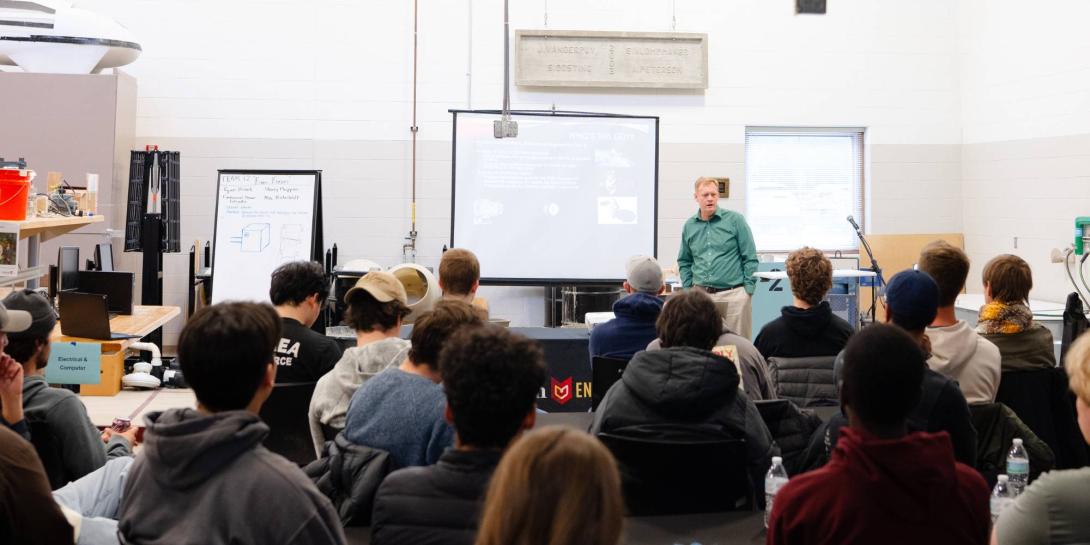
Calvin’s program gives students experience across the full satellite mission lifecycle, from design through operations.
Innovation Central Students Are Tackling Space Junk
The region’s satellite interest is not limited to higher education.
Six juniors and seniors at Innovation Central High School partnered with NASA’s Galaxy Frontier Project to research one of the most important problems in the space industry: orbital debris, commonly called space junk.
Their work focused on possible approaches to cleaning up discarded satellites, rocket components, and other debris in orbit. The students also explored the engineering and safety challenges involved in space missions before presenting their research at Kennedy Space Center.
The project gives students exposure to a problem that is becoming more urgent as satellite launches accelerate. Every new spacecraft must be designed with the broader orbital environment in mind. Engineers need to consider collision avoidance, end-of-life disposal, tracking, and the long-term sustainability of space operations.
Junior Kenneth Hood-Hood captured the appeal of that work:
“I want to be an astronaut, but then I thought, maybe it would be cooler to make the things that take them there?”
That mindset reflects the broader shift in aerospace. Space careers are not limited to astronauts. They include software developers, systems engineers, materials specialists, data analysts, mission planners, and technicians who build and maintain the equipment that makes exploration possible.
Local coverage of the Innovation Central students’ work is available through FOX 17’s report.
GE Aerospace Is Expanding the Engineering Pipeline
Grand Rapids also has a significant industrial foundation for this growth.
GE Aerospace employs approximately 1,500 people in Grand Rapids, with local work focused on avionics, mission systems, and computing systems. These disciplines connect directly to satellite and aerospace technology because they require the same core capabilities: reliable electronics, real-time computing, advanced testing, and systems that must perform under demanding conditions.
In January 2026, the GE Aerospace Foundation announced that its Next Engineers program would expand to Grand Rapids. The initiative aims to reach 4,000 students over four years, with programming scheduled to begin in early 2027.
The program will include:
- Engineering Discovery for students ages 13–14
- Engineering Academy for students ages 15–18
- Hands-on design challenges
- Career coaching
- College-readiness support
- Scholarships for qualifying graduates entering engineering programs
Dev Rajakrishna, Grand Rapids Site Leader at GE Aerospace, explained the purpose of the expansion:
“Bringing Next Engineers to Grand Rapids will expand access to hands-on engineering experiences and help build robust talent pipelines for the future.”
The GE Aerospace Foundation announcement identifies Grand Rapids as a natural fit because of its aerospace, automotive, manufacturing, and engineering connections.
Together, Calvin’s CubeSat program, Innovation Central’s student research, and GE Aerospace’s workforce investment create a progression:
- Early exposure to engineering
- Hands-on technical projects
- Advanced university-level mission work
- Professional aerospace and systems careers
That is how a technology ecosystem develops. It is built through repeated contact with real engineering problems.
What Satellite Technology Means for Homeowners
The satellite industry may sound distant from residential construction. In practice, the connection is straightforward.
Satellite imagery provides a detailed overhead view of a property. Roof-measurement systems can use that data to estimate:
- Total roof area
- Individual roof planes
- Roof complexity
- Approximate pitch
- Sections, hips, valleys, and ridges
- Material quantities
Roofers typically measure in squares, with one square equal to 100 square feet of roofing area. Getting that measurement right is essential because roof size drives material quantities, labor, disposal needs, and the starting price.
For homeowners, the advantage is speed. Instead of scheduling multiple contractors simply to obtain a ballpark figure, they can enter an address and receive an initial price range in about one minute.
The estimate can show low, middle, and high pricing for options such as:
- Architectural shingles (Popular): approximately $9,000–$13,000 for a 2,000-square-foot roof
- Metal roofing (Premium): approximately $20,000–$28,000 for a comparable roof
- Synthetic roofing (Premium): approximately $16,000–$32,000
- Roof coatings (Budget, where appropriate): approximately $6,000–$7,500
These are planning benchmarks, not final contractor bids. A physical inspection may identify conditions satellites cannot see, including rotten decking, hidden leaks, damaged flashing, ventilation issues, or structural problems.
Still, satellite measurement provides a strong first step. It helps homeowners understand the likely investment before committing time to contractor visits.

Grand Rapids Roof Planning Requires Local Context
Satellite measurements provide the physical data. Local conditions determine how that data translates into a project price.
Grand Rapids homeowners should account for:
- Snow and ice exposure
- Freeze-thaw cycles
- Wind damage
- Ice dams
- Moss and moisture retention
- Shorter installation windows during cold weather
- Older housing stock with complex roof designs
The national cost of a typical roof replacement in 2026 is roughly $9,000–$22,000, with many homeowners paying near $12,500. Actual pricing varies based on roof size, material, pitch, accessibility, labor rates, tear-off requirements, and local market conditions.
A steep roof, for example, can increase labor costs because installers need additional safety equipment and more time. A roof with multiple dormers, valleys, and sections also requires more labor than a simple ranch roof.
The practical approach is to establish a data-based range first, then compare it with detailed bids from verified local contractors.

The Satellite Edge Is Already Here
Grand Rapids is developing satellite expertise from the classroom to the factory floor. Calvin students are preparing a spacecraft for a potential 2028 launch. Innovation Central students are studying how to make orbit safer. GE Aerospace is investing in the next generation of engineers.
For homeowners, the same technology is already useful today.
A free satellite-powered roof estimate can provide a fast, transparent starting point: without a credit card, contractor visit, or obligation. Enter your address through Get My Roof Estimate Now to see your roof’s estimated size, material options, and replacement price range in approximately 60 seconds.
That is the real technology edge: advanced tools producing practical information when people need it.